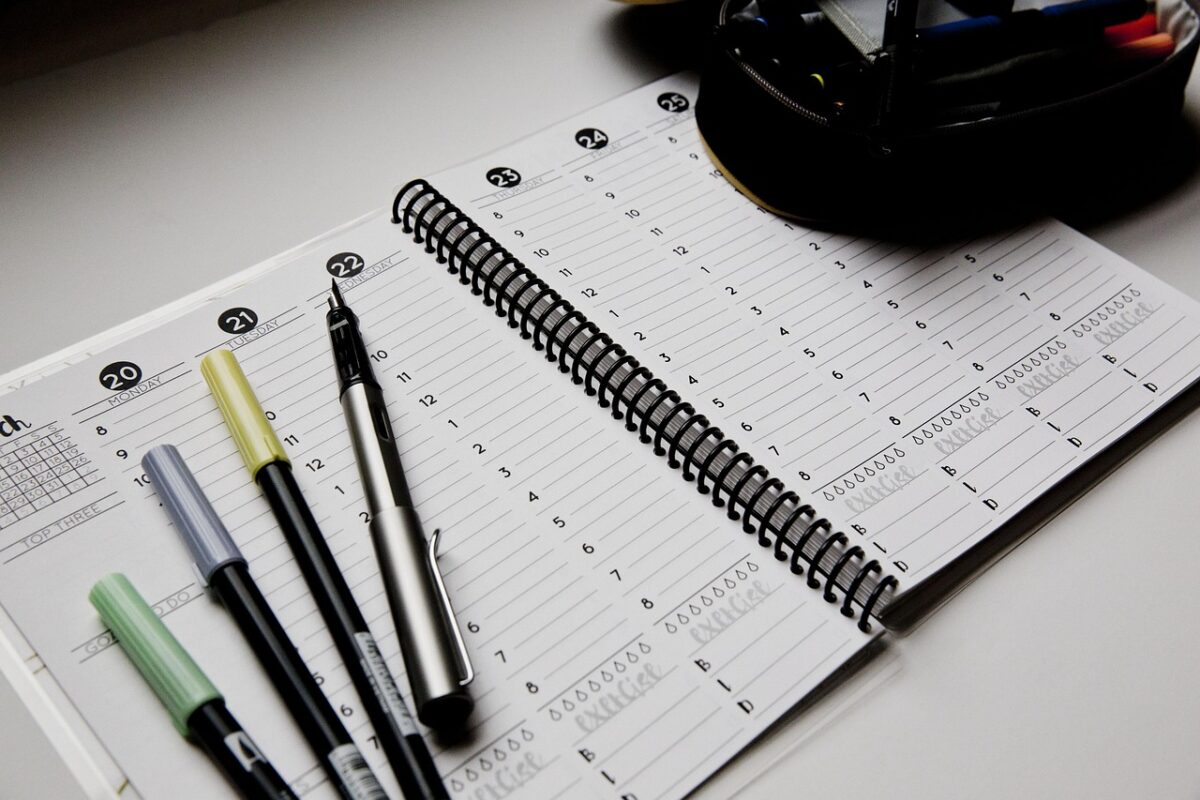
Layout gets all the attention, but size and binding decide whether a planner comes with you — and a planner left at home is not used.
Page size
Pocket (around A6)
Genuinely portable. Room for a few lines a day. Suits people who need dates and appointments with them at all times and keep detail elsewhere.
A5 (about 5.8 × 8.3 inches)
The best compromise for most people. Fits a handbag or a laptop bag, holds a usable weekly spread, and does not dominate a desk. If you are unsure, A5.
B5 (about 6.9 × 9.8 inches)
Noticeably more writing room while still portable. Good for a weekly spread with a notes page.
Letter / A4 (8.5 × 11 inches)
A desk planner. Excellent writing room, poor portability. Right if the planner lives in one place, wrong if it travels.
Binding
Spiral and twin-loop wire
Lies completely flat and folds back on itself, so it occupies half the desk space when open. The most practical binding for a working planner.
The drawbacks: the spiral catches in bags, and it can crush if the planner is dropped on its spine — a crushed spiral does not recover and pages stop turning.
Bound (sewn or glued)
Looks better and survives a bag well. Sewn bindings lie reasonably flat as they wear in; glued bindings resist and can crack at the spine if forced.
Right for anyone who values how it looks and can live with holding it open.
Disc-bound
Pages with mushroom-shaped notches that clip onto discs. Pages can be added, removed and reordered without tools.
The flexibility is genuine — you can carry only the current month. The trade-off is that pages can work loose with heavy use, and refills are proprietary to the disc size.
Ring binder
Maximum flexibility, most bulk. Suits people who build a system rather than buy one.
Paper weight
The specification that decides which pen you can use.
- Under 70 gsm: ballpoint and pencil only. Gel and fineliner will show through; fountain pen will bleed.
- 80–100 gsm: handles most pens with minor show-through.
- Over 100 gsm: takes fountain pen and marker with little bleed.
Show-through is cosmetic — you see the writing from the other side. Bleed-through is the ink actually passing through, which ruins the reverse page. If you use fountain pen, paper weight matters more than any other specification here.
The details worth having
- A back pocket for loose paper. More useful than it sounds.
- A ribbon marker, ideally two — one for the current week, one for the monthly view.
- Tabs if the planner is thick. Finding the current month in a 400-page book without tabs is a daily irritation.
- An elastic closure if it travels in a bag.
The test that matters
Will you carry it? A planner that is slightly too big to take with you gets replaced by your phone within a month, and then it is a notebook you feel guilty about.
Our listings state page size, binding and, where the manufacturer publishes it, paper weight. Browse the full range.