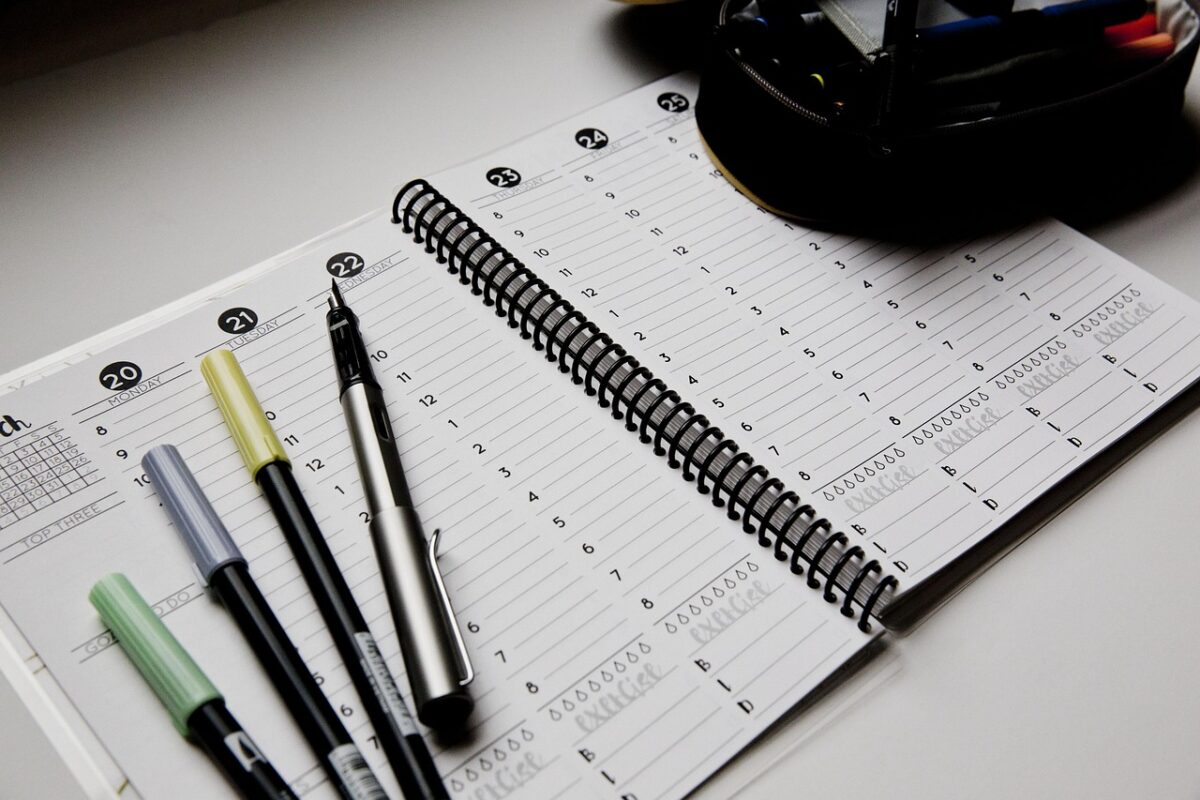
A planner and a wall calendar do different jobs. The planner is yours and travels with you. The wall calendar is the household’s or the team’s, and its value is that everyone can see it without asking.
What a shared calendar is for
Not detail. Its job is to answer, at a glance and without a conversation: who is away, what is happening this week, when is the deadline.
The failure mode is treating it as a second personal planner, filling it with individual tasks. It becomes unreadable and people stop looking.
Wall calendar formats
Month per page
The standard. Good balance of visibility and detail — each day holds two or three short entries.
Year on one sheet
The whole year visible. Excellent for planning holidays, terms and long projects; useless for day-to-day detail. Best used alongside a monthly calendar rather than instead of it.
Quarterly (three months visible)
A good compromise where things are planned six to twelve weeks out. Takes more wall.
Size and legibility
The question is how far away it will be read from. A calendar read from across a kitchen needs bigger date boxes than one read from a desk.
As a rough guide, a 12 × 15 inch monthly calendar is readable from about two metres. If it will hang in a corridor or an open office, go larger.
Writable or not
Many decorative wall calendars have a coated surface that pen sits on top of and smudges. If the calendar is to be written on, check the surface takes ink — or choose a laminated one and use a dry-wipe marker, which has the advantage that it corrects cleanly.
Desk pad calendars
A large monthly pad sitting on the desk under your work.
Good at: being permanently visible without opening anything, and giving generous writing room. The month is simply there.
Less good at: travelling, obviously, and it consumes desk space. It works best as a companion to a portable planner rather than a replacement.
Undated desk pads are common and useful — you can start any month, and an unused sheet is not wasted.
Making a shared calendar work
- Agree what goes on it. Usually: anything affecting more than one person. Not personal to-do items.
- One pen, kept with it. A calendar without a pen nearby does not get written on.
- Colour by person, if there are several. This is the one place a colour system reliably survives, because each person only needs their own.
- Hang it where people already stand. By the kettle, by the door, above the printer. A calendar in a room nobody lingers in is not consulted.
Household use
For families, a monthly wall calendar in the kitchen with a column or colour per person handles most of what is otherwise negotiated by text message. Add school terms and holidays at the start of the year.
Team use
Where a team already uses a digital calendar, a wall calendar still earns its place for the things nobody puts in a digital calendar: deadlines, delivery dates, who is on leave. It is a summary, not a duplicate.
Buying at the right time
Wall calendars for the coming year appear in autumn and the good ones sell through. If a specific format matters to you, buy early — the choice in January is whatever is left.
See our Wall & Desk Calendars, with the exact date range on every listing.